Bor & co.

Process // Pipeline

How hardware gets fabricated.

One pipeline, every unit. Grillz, signet rings, and the categories on deck all move through the same four phases — scan, design, manufacture, finish — engineered against the captured anatomy and audited at sub-25-micron tolerance from the lab in Canggu. The page below is the protocol, end to end.

Doc
Process // Pipeline
Edition
2026 // V0.33.0
Tolerance
<25 microns
Lab
Bali // Global

01//Pipeline

Four phases.Every unit. Every alloy.

Hardware is engineered, not crafted. Grillz, rings, and every category on deck run through the same four phases — only the capture method and the bench time change.

01 //

Scan

Every commission starts from the body. Grillz begin with a sub-25-micron intraoral scan — taken at the bench in Canggu or transmitted from a partner dentist. Rings begin with a calibrated finger sizing at the seat position. Future hardware classes carry their own capture protocols. The output is the anatomical reference your unit will be engineered against, archived on file.

Grillz
Intraoral 3D scan
Rings
Finger sizing
Tolerance
<25 microns

02 //

Design

Hardware is engineered against the captured reference in the Digital Void — the CAD environment where geometry is solved before any metal moves. Snap-Fit surfaces for grillz; sized bands and engineered signet faces for rings; anatomy-mapped clips for the categories on deck. Stone positions plotted, clearance and occlusion simulated. Nothing leaves the workstation until the spec is locked.

Surface
Zbrush / Nomad / Fusion
Output
Spec-locked geometry
Platforms
Mac / iPad

03 //

Manufacture

Three fabrication pipelines, picked by alloy and geometry. Precision Centrifugal Casting for silver and gold. CNC Milling for subtractive work from solid medical-grade blocks. SLM — Selective Laser Melting — for titanium and CoCr, the same fabrication class deployed on aerospace turbine blades and surgical implants.

Casting
Silver / Gold alloys
CNC
Subtractive from solid
SLM
Titanium / CoCr

04 //

Finish

Mirror polish, matte texture, or electroplated finish. Stones set by hand under loupe — moissanite, VVS lab diamond, VVS natural diamond, Australian opal. Final pass is a category-specific fit audit: Snap-Fit verification for grillz, sizing check for rings, integrity tests for every other class. Units that drift outside tolerance return to the pipeline.

Polish
Mirror / Matte
Plating
Yellow / Rose / Rhodium
Setting
Per-stone, by hand
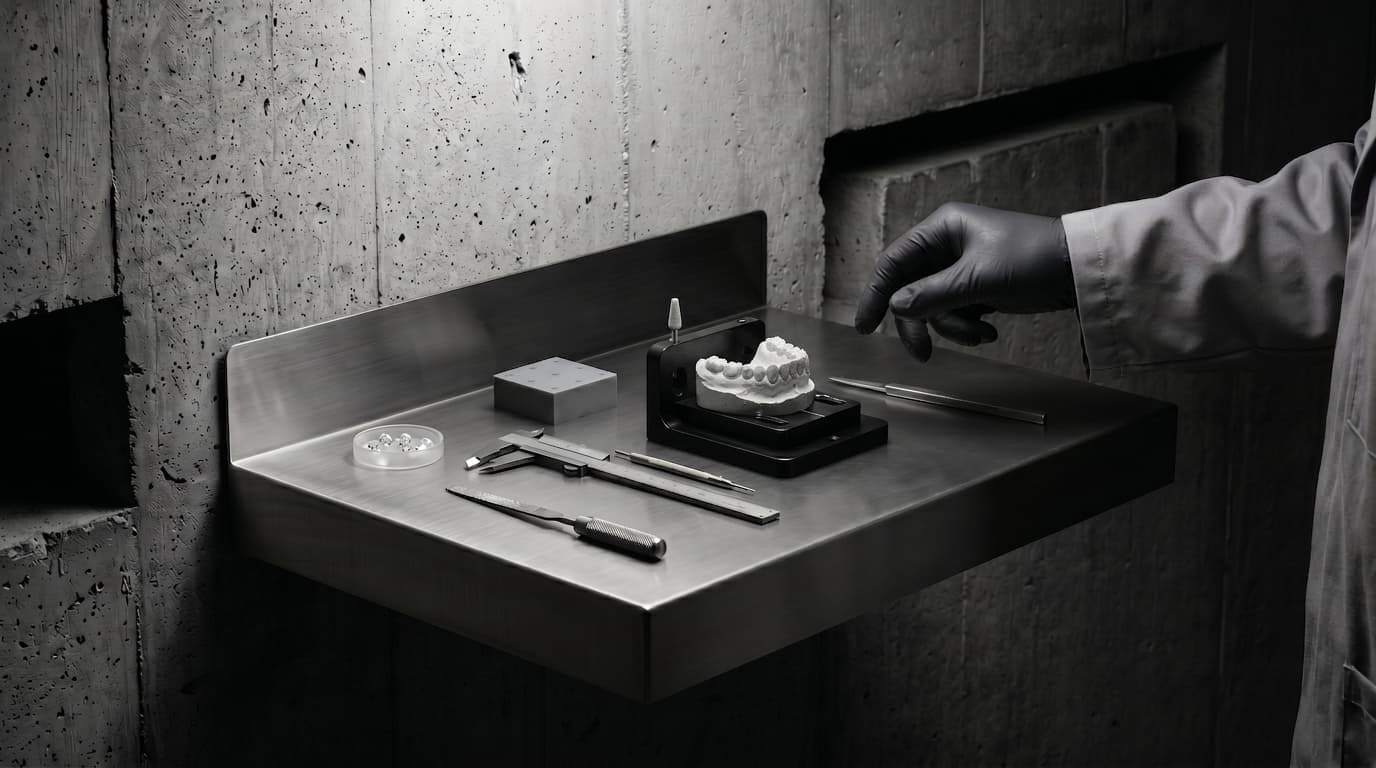
Brutalist wall-mounted stainless-steel bench in concrete-walled lab. Gloved hand setting stones on a 3D-printed dental cast with grillz, caliper and hand-piece file laid out alongside a petri dish of diamonds.

Interlude // Bench

/work/bench_macro_001.jpg

Sub-millimeter tolerance.Bali // P-001 calibration.

02//Techniques

Three pipelines. Picked by alloy.

Phase 03 expanded. Hardware ships through one of three fabrication routes — the studio picks the route the moment your spec is locked. None of the three is the catch-all; each exists because the others fail at something specific.

T-01

Precision Centrifugal Casting

Wax pattern grown from CAD, vacuumed in plaster, molten alloy thrown into the void under centrifugal force. The wax burns off as the metal sets. Reproduces geometry at sub-millimeter tolerance with the grain structure suited for stone-setting and daily wear.

Alloys
Silver // 10K–22K gold
Pattern
CAD-grown wax
Best for
Grillz // signet rings

T-02

CNC Milling

Subtractive fabrication from solid medical-grade blocks. No porosity, no fusion lines, no cast grain. Reserved for hardware that needs continuous metal integrity — certain ring shanks, structural titanium parts, custom tooling that has to take repeated load without seam failure.

Method
Subtractive
Stock
Medical-grade blocks
Limit
Tool-accessible geometry

T-03

SLM // Selective Laser Melting

Fine titanium powder fused layer-by-layer by a focused laser. The same fabrication class deployed on aerospace turbine blades and orthopedic implants. Enables internal voids, lattice structures, and weight-optimized geometries impossible in subtractive milling.

Alloys
Titanium // CoCr
Build
Layer-by-layer
Bio-grade
Yes

03//Tolerance

Sub-25 microns. What that means.

The figure isn't a marketing claim — it's the acceptance criterion that gates every phase of the pipeline. A unit that drifts outside 25 microns at any audit gets returned to the bench. Hardware ships when it doesn't drift, not when the bench runs out of time.

Reference // Scale

A micron is one-thousandth of a millimeter. Twenty-five microns is roughly half the width of a single red blood cell, and a third the diameter of a human hair. Every commission — grillz, ring, or otherwise — is referenced against the captured anatomy at that scale, from capture through CAD geometry to the final bench audit.

The tolerance is what makes Snap-Fit reversible on a grillz, sizing exact on a ring, and every future category lifetime-stable on the body. A 50-micron drift on a cap is the difference between a unit that seats every time and one the wearer stops trusting after three weeks. A ring band drifts the same way. We hold the figure because the geometry doesn't forgive anything looser.

1 micron
1 / 1,000 mm
Red blood cell
≈ 7 microns
Human hair
≈ 70 microns
Pipeline gate
<25 microns

04//Enter the pipeline

Configure in 3D.Commission directly.

Two studios are open. Configure grillz against your dental geometry, or configure a signet ring against your finger size — both render in 3D, both quote against current spot price, both feed the same fabrication pipeline.

$WhatsApp // +62 877 2274 3010//info@borandco.id

WhatsApp